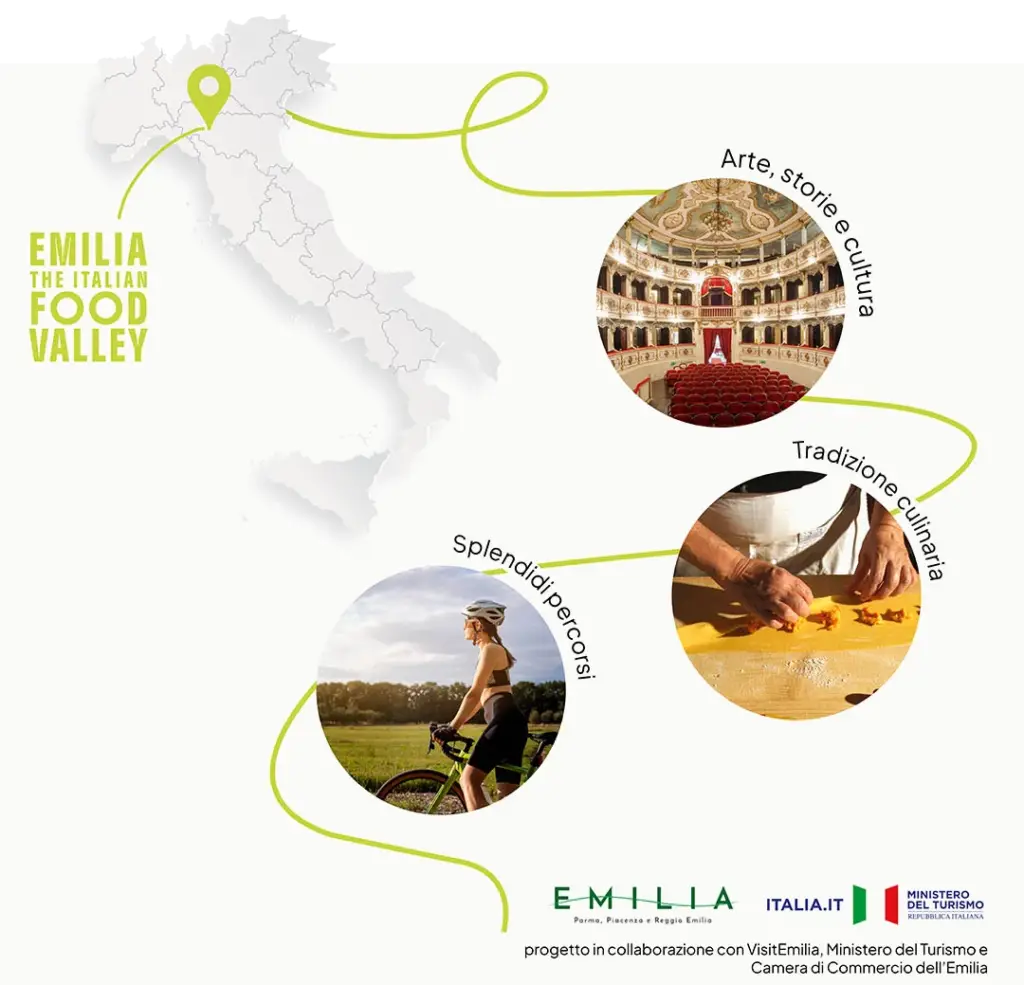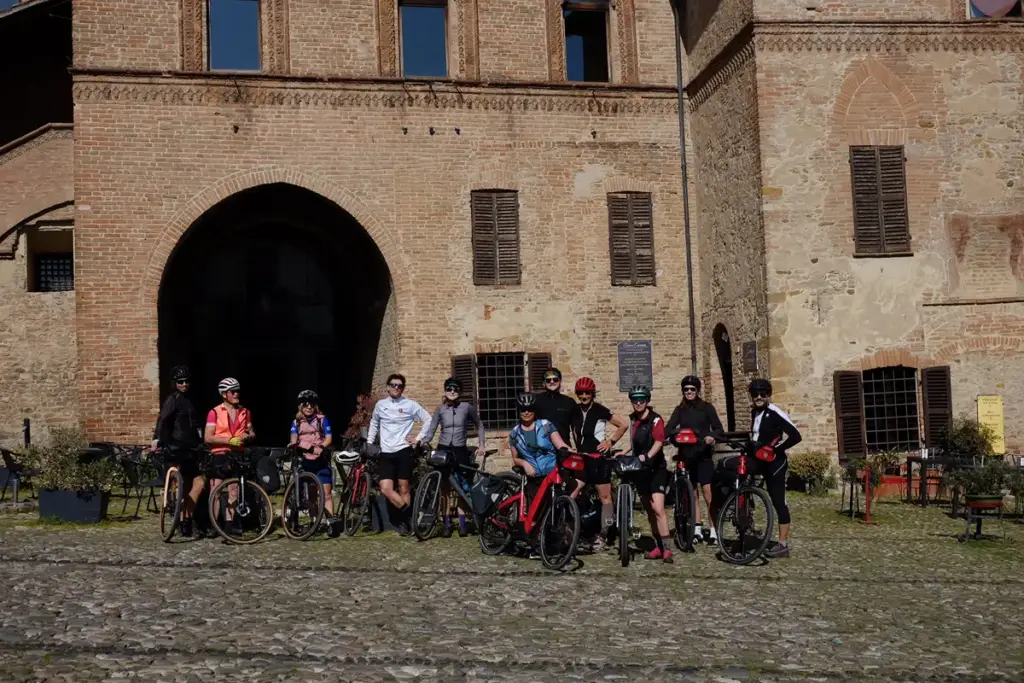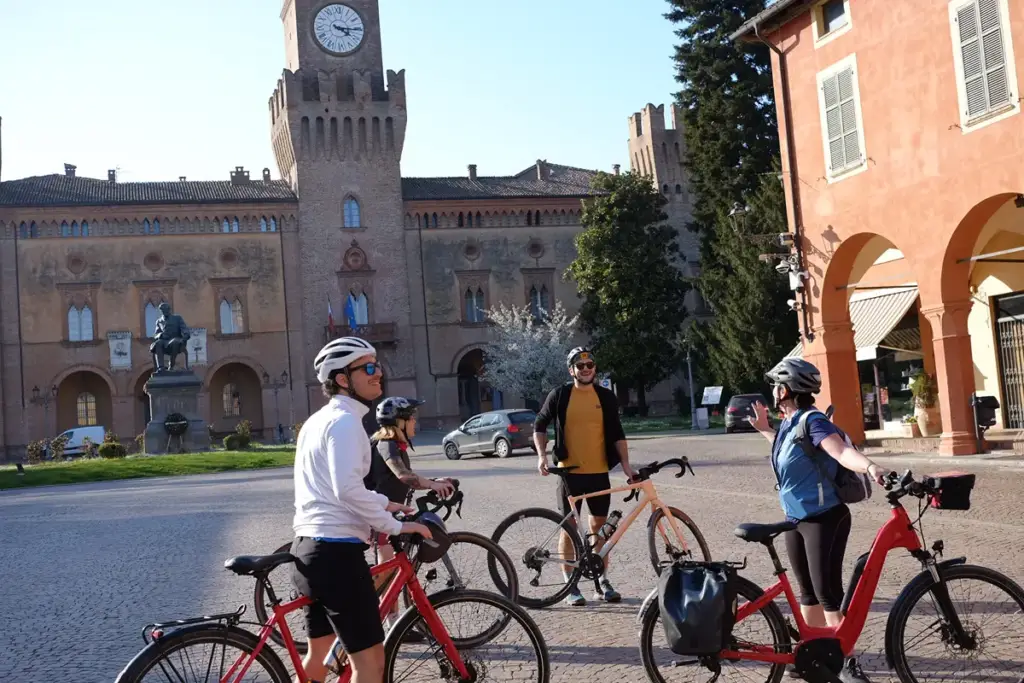


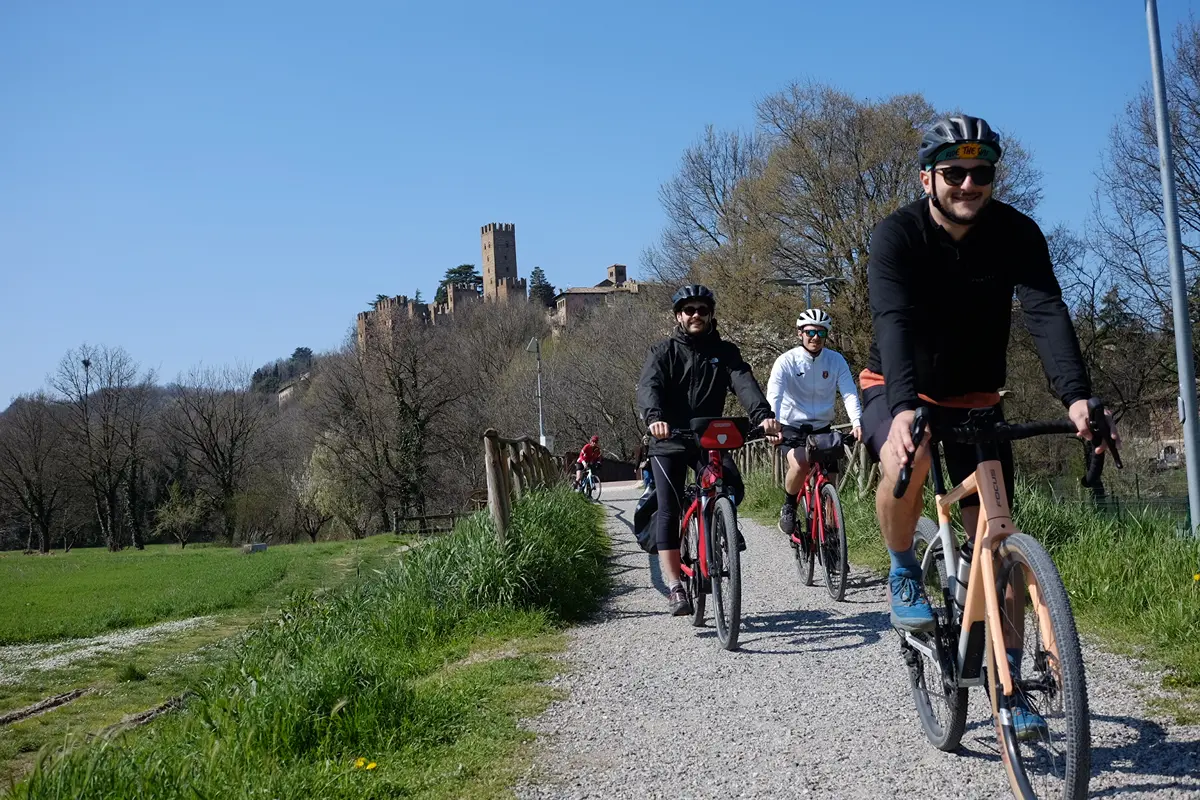
This cycling tour from Piacenza to Parma runs through the heart of Emilia’s Food Valley: a flat route of around 300 kilometers through medieval castles, historic villages, vineyards and producers of excellence such as Parmigiano Reggiano DOP and Prosciutto di Parma DOP. It’s one of the most complete cycling routes in Northern Italy, ideal for anyone who wants to combine outdoor activity, culture and authentic gastronomy.
What is Emilia’s Food Valley, and why cycle through it
The term Food Valley refers to the area spanning the provinces of Piacenza, Parma and Reggio Emilia, home to some of the world’s most recognized protected designation of origin products: Parmigiano Reggiano, Prosciutto di Parma, Culatello di Zibello, Coppa Piacentina, Lambrusco. This isn’t just about food. It’s a landscape shaped over centuries around these products: farmhouses, vinegar cellars, ham curing houses and dairies dotting the plain between one village and the next.
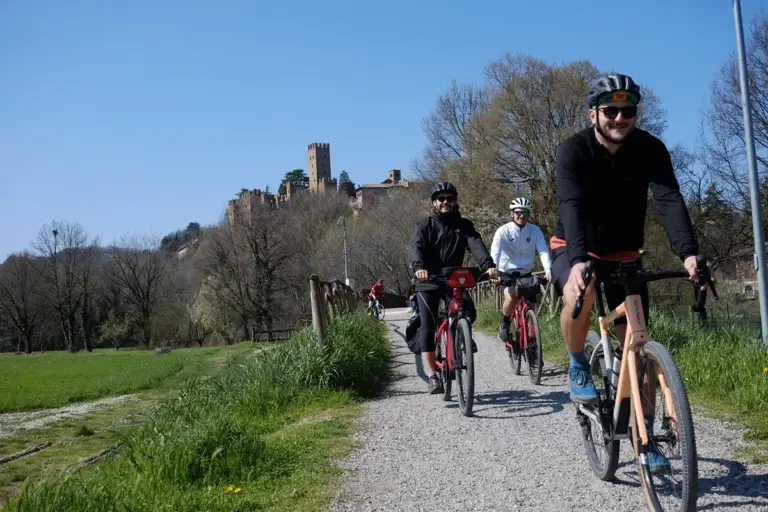
The bicycle is the ideal way to cross this territory, still intact and largely unknown to crowds of tourists. The routes follow secondary roads and dedicated cycle paths, mostly flat, at a pace that lets you stop, look, understand. At 60 km/h you pass through. At 15, you notice everything.
The Itinera Bike route mostly follows paved roads and compact gravel tracks. Total elevation gain is minimal: around 60 km a day with a maximum gradient of 2% on the flat sections. Suitable for recreational cyclists and anyone who enjoys outdoor activity. The tour works for everyone, especially with the option to ride an e-bike.
The route, stage by stage:
Stage 1: Piacenza, where the Via Emilia begins
Piacenza is the starting point of the tour. It’s a city most travelers pass through without stopping, yet it deserves at least a morning. The Palazzo Gotico in Piazza Cavalli dates back to 1280 and is one of the best preserved examples of medieval civic architecture in Italy. The Civic Museums house the Piacenza Liver, an Etruscan bronze model from the 3rd century BC used for haruspicy. The Via Emilia starts here: 2,000 years of history under your wheels, quiet roads that let you take in these places still off the mass tourism map.
Stage 2: Fiorenzuola d’Arda and the Castell’Arquato loop
The second stage heads toward the first hills of the Piacenza area. The Castell’Arquato loop is the hilly detour on the route: 39.5 km with 424 meters of elevation gain and a maximum gradient of 7%, which an e-bike makes effortless, letting you enjoy the climb up to Castell’Arquato, one of Italy’s best preserved medieval villages. The Rocca Viscontea was built in 1342 by Luchino Visconti. The medieval square, the 12th century Romanesque Collegiata and the view over the Arda Valley have remained unchanged for 700 years.
Stage 3: Fontanellato and the Bassa Parmense
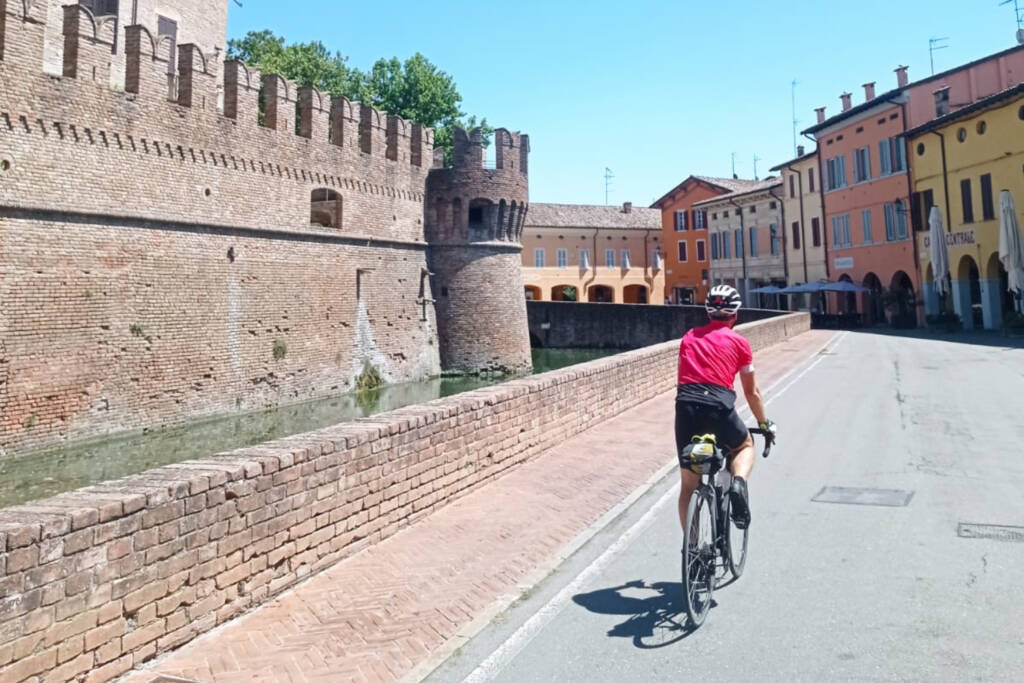
The third day takes you into the heart of the plain, along roads lined with poplar trees and wheat fields. Fontanellato is not to be missed: the Rocca Sanvitale is one of the few Italian castles completely surrounded by a moat with running water. Inside, in a private chamber, Parmigianino painted the Diana and Actaeon cycle in 1524, one of the masterpieces of Italian Mannerism, still largely unknown to international visitors.
This area is also home to Culatello di Zibello DOP, the finest cured meat of the Po Valley, produced only in this stretch of land where winter fog and humidity from the Po River create the microclimate conditions needed for curing.
Stage 4: Colorno, the palace on the river
Colorno is home to the Reggia dei Farnese, the summer residence of the Dukes of Parma in the 17th century, known as Emilia’s little Versailles. Today it houses ALMA, the world’s most prestigious Italian culinary school. Cycling through the palace park toward the Po River is one of the most photogenic moments of the entire route.
Stage 5: Parma, arriving in one of Italy’s most refined cities
Parma is the final destination and deserves at least two days. The Romanesque Baptistery in Piazza Duomo was begun in 1196 by Benedetto Antelami. The Camera di San Paolo houses Correggio’s 1519 frescoes, painted for a private chamber and preserved in place for five centuries. The Teatro Farnese, built in 1618, is the oldest surviving large wooden theater in Europe. And of course, Parma is a place to eat: ham curing houses on the edge of town, dairies in the surrounding countryside, historic trattorias in the center.
The tour ends in Parma on Friday. Booking a train for Saturday or Sunday leaves one or two full days to explore the city at leisure.
What you’ll eat along the way: the DOP products of the Food Valley
This territory is home to some of the most copied and imitated protected designation of origin products in the world, though never successfully. The reason is simple: these products can’t be replicated outside this area because they depend on the air, the climate, the water and a production tradition passed down for centuries.
Parmigiano Reggiano DOP
Made the same way for 800 years. One wheel requires 550 liters of milk and at least 12 months of aging.
Prosciutto di Parma DOP
Aged for a minimum of 14 months in the dry air of the Langhirano hills. Just salt and pork leg: no additives, no preservatives.
Culatello di Zibello DOP
The finest cured meat of the Po Valley. Produced only in the Bassa Parmense, it ages in humid cellars for 12 to 36 months.
Lambrusco DOP
Emilia’s sparkling wine: red, dry or semi-sweet, perfect with cured meats. It comes in several varieties (Grasparossa, Salamino, Sorbara).
When is the best time to cycle through Italy’s Food Valley?
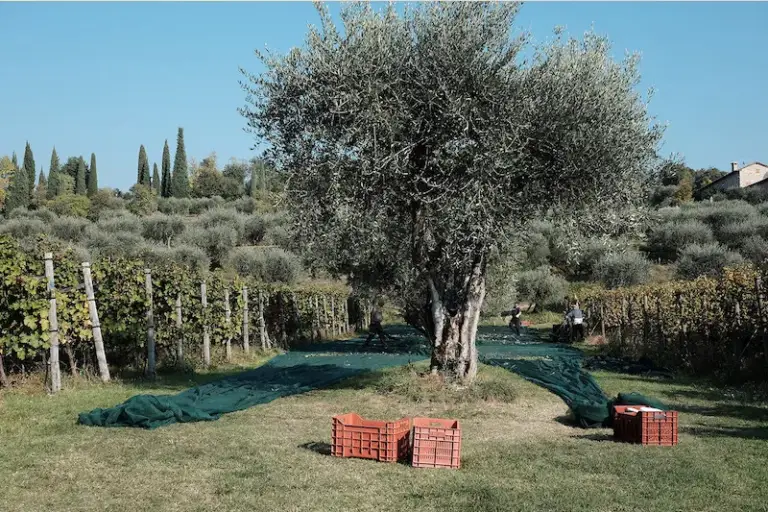
Departures run every Sunday from April to October. Itinera Bike recommends September for three reasons: it’s harvest season in Valpolicella and the Piacenza hills, the late summer light over the plain is remarkable, and tourist numbers are noticeably lower than in July and August. October is the second best choice: the morning fog over the plain is a unique visual experience and the roads are nearly empty. April and May are ideal for those who prefer cooler temperatures and green landscapes. Avoid peak August: the heat of the Po Valley can be intense during the middle of the day.
FAQ | Frequently asked questions about the Food Valley tour in Italy
What fitness level is needed for the Piacenza to Parma tour?
The route suits everyone, especially with an e-bike. Sixty kilometers a day on flat terrain doesn’t require athletic training. The Castell’Arquato loop (stage 2) is the only section with some elevation gain and can be skipped on request, but it’s manageable even on a regular bike, and effectively irrelevant on an e-bike.
What type of bike is suitable for the route?
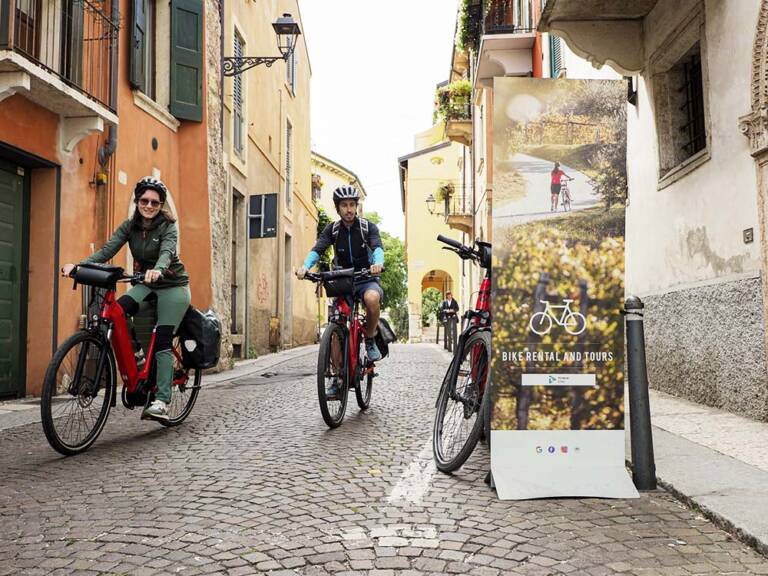
The surface is almost entirely paved or compact gravel. A trekking bike, a gravel bike or an e-bike all work well. Itinera Bike offers rental bikes fitted to each rider.
Is luggage transported?
Yes, luggage transport is included. Your main luggage is transferred from one hotel to the next each day. Itinera Bike’s rental includes spacious waterproof bags for carrying the essentials for each stage. Logistics are included in the tour price.
Does the tour use an app? How does navigation work?
The tour is self-guided, with an app that provides turn-by-turn navigation along with detailed notes that make the self-guided experience complete.
Itinera Bike has built a full set of route notes into the app, covering historical, artistic, cultural and food and wine information about the main points of interest you’ll find along the way. The app also includes selected stopping points, with restaurant recommendations (including opening hours) and tips on where to have unforgettable culinary experiences: where to try that local cake, that sandwich with regional cured meats and cheeses, where to taste the best wine in the area.
Our advice is to read the app’s notes the evening before, so you already know the territory you’ll be riding through the next day.
You’ll also find tips on how to cycle safely in Italy.
The app is available for both iOS and Android and is included in the package.
What’s included in the tour price?
Accommodation, breakfasts, luggage transport, access to the navigation app and Itinera Bike’s support throughout the trip are all included. Lunches and dinners are up to you: every cyclist chooses where to stop.