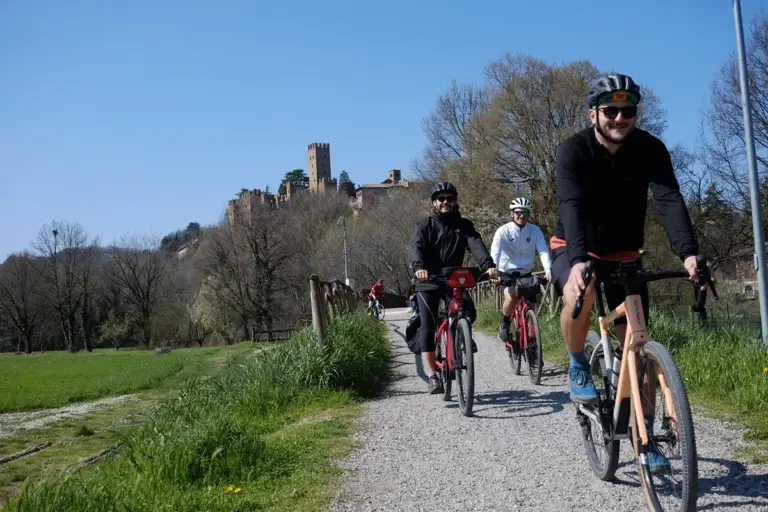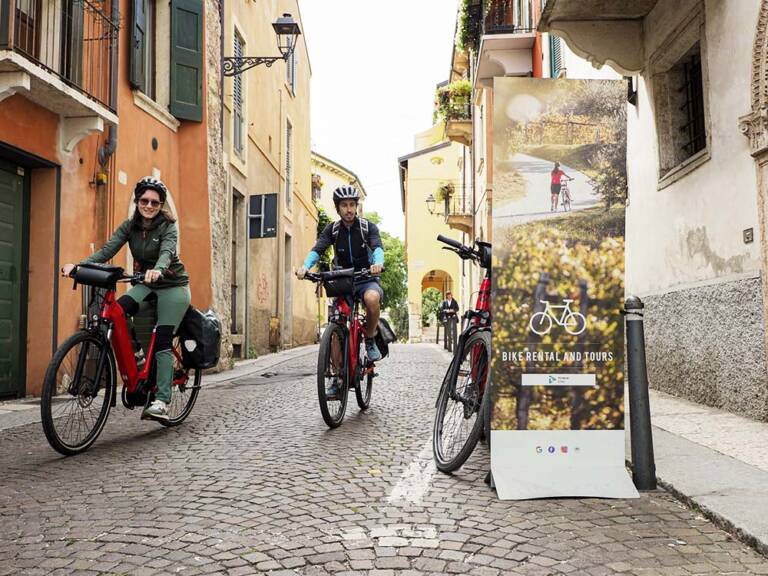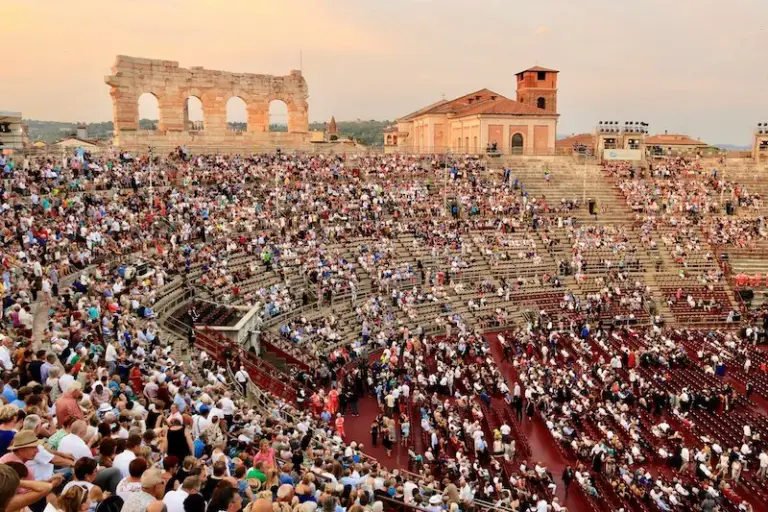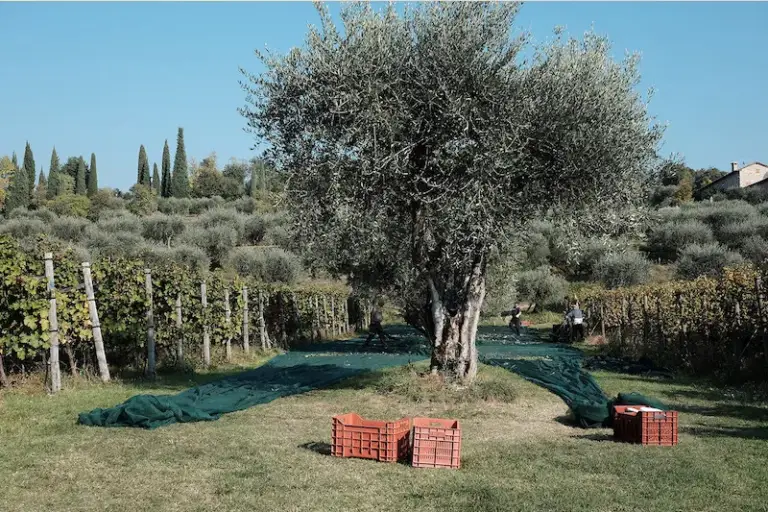


“Gravel” is an English word that literally means crushed stone. But anyone who rides knows it means much more: the smell of wet earth after rain, the vibration of pebbles under your wheels, the unmarked bend that asks you to make a call. This is the guide we use to tell our guests what they will find, before they even clip in.
What a gravel route really is and why it is not just about the surface
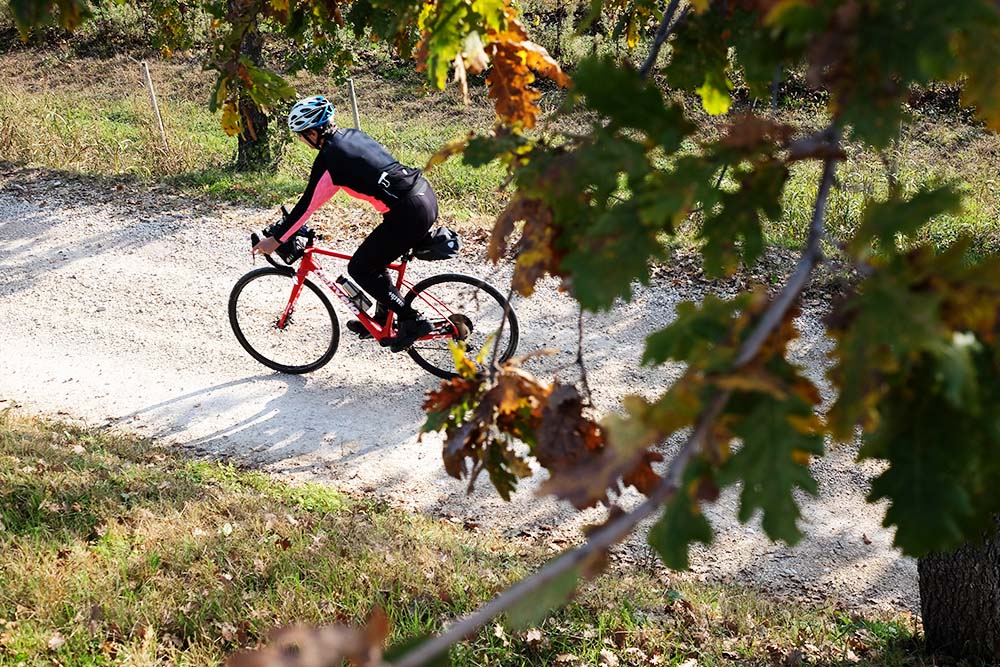
In cycling, “gravel” refers to any route that leaves the tarmac: dirt tracks, packed gravel roads, farm lanes, forest paths, woodland trails. But the technical definition does not capture the experience.
A gravel route is, above all, a route that changes. It starts on asphalt, then turns onto a white road, then enters a wood, then climbs a farm track between the vineyards. You are not riding on a uniform, predictable surface you are riding through a landscape. That calls for a different bike and a different mindset than road cycling.
In northern Italy, and around Verona in particular, gravel has a precise geographical meaning. The glacial hills of Lake Garda, the white roads of Valpolicella, the trails across the Lessinia plateau, the forest tracks of the Prealps: all of this is gravel. Living terrain, not cycling infrastructure.
But there is something else, too. Those who choose gravel want to get away from traffic, away from buildings. It is a desire for open, natural space. We do not have the vast plains of the American Midwest or the endless forests of Finland, but we have an extraordinarily varied landscape and places that can only be reached by leaving the road behind. Gravel is not a shortcut between two points on tarmac. It is the choice of a different surface because that surface leads somewhere asphalt cannot.
How to read gravel difficulty: our 5-level scale
When we plan a gravel route, we do not just look at the distance and elevation. We look at the surface and we classify it. Because two routes that are identical on paper can feel completely different depending on road quality, trail width, loose rocks, or wet and slippery sections.
Over time, we have developed a 5-level scale that we use internally and share with our guests before they set off. It is the same method we use every time we ride a route for the first time, or after a season of heavy rain.
G1: Compact dirt, close to tarmac Well-maintained farm tracks, fine pressed gravel, cycling paths on former railway lines. Predictable surface, wide enough to ride without worrying about your line. Suitable for any bike with tyres of 35 mm or wider. Examples: sections of the Ciclovia dell’Adige off the main route, flat white roads across the Po Plain.
G2: Variable dirt, some loose stones Hilly white roads with an uneven surface, short sections of coarser gravel, farm lanes rutted by tractors. The surface changes and demands attention, but no specific technique. Tyres of 38 mm or wider. Examples: white roads of Valpolicella, vineyard tracks around Bardolino, glacial hills on the eastern shore of Lake Garda.
G3: Coarse gravel, woodland trails, uneven gradients Sections with larger stones, forest tracks with roots and potholes, loose gravel on descents. Requires a gravel bike with 40 mm knobby tyres and some experience handling the bike on the way down. Examples: trails in the Lessinia, mountain roads above Fumane and Marano di Valpolicella.
G4: Technical surface, active riding Narrow singletrack, rocky sections, exposed loose gravel on descents. You cannot ride on autopilot: you need to pick your line, modulate braking, and manage your weight on the bike. Not mountain biking, but getting close. Tyres of 42 mm or wider, off-road riding experience required. Examples: some climbs in the Veronese Prealps, trails on Monte Pastello.
G5: Adventure: unpredictable surface, variable conditions Routes on unmaintained natural terrain, with possible muddy, sandy or rocky sections. Cannot be planned with certainty — conditions depend entirely on recent weather. Require technical skill, a specific bike, and the ability to read the ground in real time.
A real gravel route almost always combines several levels in a single day. A ride in Valpolicella might start on G1 (compact dirt between the vines), climb to G3 (a woodland trail), return to G1, and finish on tarmac. When we assign a level to a route, we mean the highest level you will encounter, not the average.
One useful clarification: the Itinera Bike gravel catalogue covers routes from G1 to G3. G4 and G5 belong to a different kind of experience, closer to mountain biking, and are not part of our touring offer.
The right bike for gravel: what actually matters
A gravel bike has specific design features: drop handlebars (like a road bike), a more stable and relaxed geometry, wide knobby tyres, and disc brakes. It is built to be fast on tarmac and confident on dirt — a well-judged compromise between a road bike and a mountain bike.
But it is not compulsory. What really matters is not the brand of the bike, it is the tyre. A tyre that is too narrow (under 35 mm) loses traction on G2 and G3 surfaces, slides, and struggles on descents. A 40 mm knobby tyre solves most problems on routes up to G3.
What we check when we assess a bike for a gravel route
Tyre width: 35 mm minimum for G1-G2, 40-45 mm recommended for G3. The tread pattern (knobby vs slick) makes a real difference on wet surfaces and loose gravel.
Tyre pressure: a wide tyre run slightly soft absorbs vibration better and increases the contact patch with the ground. On gravel you run lower pressures than on tarmac. We handle this before you leave.
Disc brakes: essential for consistent, modulated stopping power on uneven surfaces, especially on G3 descents. Every bike in our gravel fleet has them.
Geometry: a bike with a more stable setup, longer wheelbase, slacker head angle, is less twitchy on rough terrain. Not all gravel bikes are equal in this respect.
At Itinera Bike, the gravel bikes in our fleet are chosen for cycle touring on G1-G3 surfaces. They are not race bikes they are travel bikes built for dirt. Before we assign one to you, we ask where you want to go and what kind of terrain you will be riding. Then we set the tyre pressure to match your specific route.
Why mixed surfaces are a feature, not a flaw
First-time gravel riders often ask: “how much of it is actually dirt?” As if the proportion of tarmac were reassuring and the proportion of gravel were a risk to be calculated. That perspective tends to shift once you are out there.
The value of a good gravel route lies precisely in the variety: a stretch of tarmac to find your rhythm, then a turn onto dirt that opens a completely different landscape, then a short forest path, then the road again. The paved sections are not the “normal” part of the route — they are the transitions. They let you catch your breath, take in the view, refill your water before heading back onto rougher ground.
In Valpolicella this alternation works particularly well. You leave Verona on tarmac, climb between the vineyards on white roads that smell of earth and vine leaves, enter a narrow woodland trail, then descend on a farm track with a view across the lake. In an hour and a half of riding, you pass through four completely different landscapes. None of them are reachable on tarmac alone.
Gravel does not reject the road. It leaves it behind when there is something better on the other side.
The gravel routes we know best: from Verona and the surrounding area
Valpolicella wine gravel — G1/G2 The most approachable route for anyone new to gravel. Starting from Verona or San Pietro in Cariano, you ride through the Amarone vineyards: well-maintained white roads, very little traffic, moderate elevation. Along the way you pass wineries producing some of Italy’s most celebrated reds. The route works in any season, but in September, during the harvest, it is something else entirely. Distance: 40-55 km. Elevation: 600-800 m. Bike: touring bike with 38 mm tyres or gravel bike.
Lessinia plateau — G2/G3 The Lessinia plateau is the most varied gravel terrain within easy reach of Verona. Riding at 1,000-1,200 metres, you cross forest tracks, agricultural and forestry roads, and short trails through beech woods. The surface shifts constantly: packed, then rougher, then coarse gravel on the descents. The views across the plateau and towards the Prealps are among the most peaceful you will find within an hour of the city. Distance: 45-70 km depending on the loop. Elevation: 1,000-1,400 m. Bike: gravel with 40 mm knobby tyres. Not suitable for a standard touring bike.
Glacial hills of Lake Garda — G1/G2 The glacial hills between Verona and Lake Garda are threaded with a network of white roads and farm tracks connecting villages, olive mills, and wineries. The surface is almost always compact, with rolling elevation and no punishing climbs. This is the right route for anyone who wants to explore the Garda hinterland away from the crowds on the lakeside. In spring the olive trees flower; in autumn it is harvest time. Distance: 35-60 km. Elevation: 400-700 m. Bike: touring bike with 38 mm tyres or gravel bike.
Lake Garda between the Alps and the hills — G2/G3 There is far more to the Garda area than the circuit of the lake. Move away from the shore and climb towards the first ridgelines, and you find a network of white roads and agro-forestry tracks connecting inland villages, terraced olive groves, and woodland with views down to the water. The surface alternates between compact dirt and rougher sections with coarse gravel on the climbs. The elevation is manageable, and the landscape earns every metre: the lake and the plain below, the Prealps all around. Distance: 45-65 km depending on the route. Elevation: 800-1,200 m. Bike: gravel with 40 mm knobby tyres. Not suitable for a standard touring bike on the more technical sections.
FAQ | Frequently asked questions about gravel riding in northern Italy
Do I need to be an experienced cyclist to ride gravel? Yes, a baseline of fitness is required. Gravel is not suitable for complete beginners, even on the most accessible routes: uneven surfaces demand a degree of confidence in the saddle and bike-handling ability that only comes with regular riding. If you ride a couple of times a week, you will be fine on the G1-G2 routes in Valpolicella or the glacial hills. The G3 routes in Lessinia and around Lake Garda require off-road experience and the right bike. The most important thing is to choose a route that matches your actual level, not the one you would like to have.
Can I ride gravel on my road bike? Better not. A road bike with 32 mm tubeless tyres can handle G1 surfaces and light G2 sections, but beyond that the risk of punctures rises sharply and control on descents deteriorates. If your road bike runs less than 32 mm of tyre, it is not the right choice for gravel: you are better off renting a gravel bike that is already set up for what you will find under your wheels.
Is the GPX track reliable on gravel routes? Yes, with one important note. The tracks we give our guests are kept up to date and include notes on any tricky sections, but gravel always calls for a degree of mental flexibility to handle the unexpected. When we select a route, we always plan for the possibility that the rider might be out there in the rain, or just after a downpour. That is why we choose stable surfaces that can be ridden in any weather: no dried-mud tracks that turn to swamp after rain, no sandy paths near rivers that shift with rising water levels. The GPX tells you where to go. Our route selection tells you that you can go there whatever the weather.
Does Itinera Bike offer guided gravel rides? Yes, on request. For G3 routes in Lessinia and across the Lake Garda hill territory, we always include a local guide who knows the terrain in every season and can spot where a trail becomes tricky after rain. For G1-G2 routes we provide a GPX track, route notes, and phone support throughout.
We are also developing new gravel itineraries across the Veneto region: from the Prealps foothills through the Prosecco hills, across the Po Delta, and along the Adriatic coast. Both self-guided and guided group formats. Write to us at itinerabike.com to plan a custom ride or to find out what is coming next.
“`